
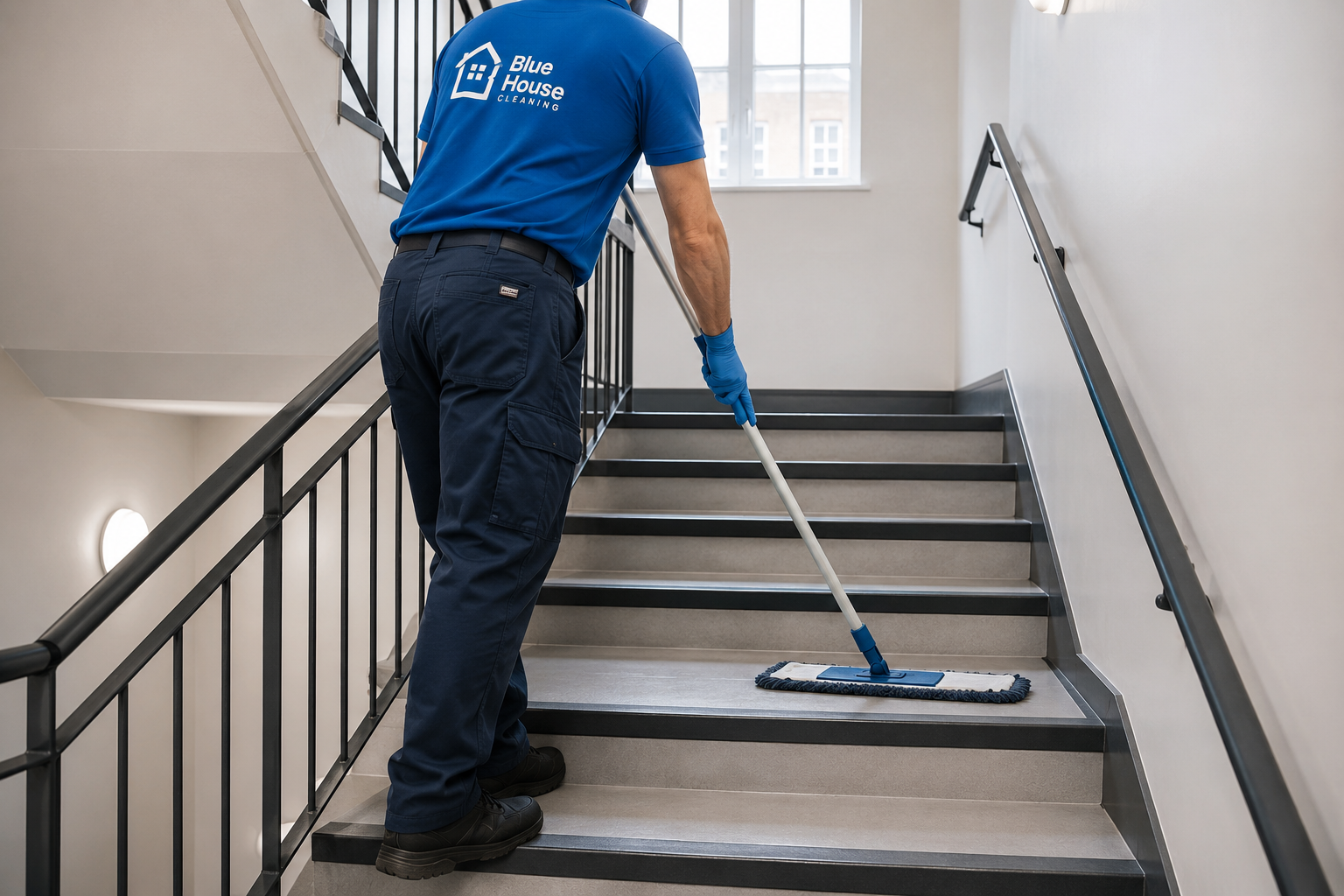
Of all the communal spaces in a residential block, the stairwell is perhaps the most important — and the most overlooked. Every resident uses it multiple times every day. It connects every floor, every flat, and every household in the building. And in the event of an emergency, it is the primary evacuation route for every person in the property.
Yet stairwells are consistently among the least well maintained communal areas in residential blocks across Brighton. They accumulate dirt, debris, and moisture rapidly. They present genuine slip and trip hazards when neglected. And they are subject to specific legal requirements that managing agents, freeholders, and landlords in Brighton cannot afford to ignore.
Professional stairwell cleaning in Brighton is not a luxury or an afterthought — it is a fundamental requirement of responsible block management. In this post, we explain exactly why clean stairwells matter so much for hygiene, safety, and legal compliance, what a professional stairwell clean includes, how often it should be carried out, and what the law actually requires of those responsible for residential blocks in Brighton and Hove.
Why Clean Stairwells Matter — Hygiene and Safety
The Hygiene Case
Stairwells are high traffic communal spaces that accumulate dirt, dust, and debris faster than almost any other area in a residential block. Every resident, visitor, and tradesperson passing through tracks in outdoor contaminants — mud, leaves, moisture, and general street dirt — that build up on stair treads, landings, and floor surfaces with every passing day.
In addition to visible dirt, stairwells harbour less visible hygiene concerns that regular cleaning addresses. Dust accumulates on handrails, skirting boards, and light fittings. Mould develops in poorly ventilated stairwells where moisture is not regularly cleaned away. Bacteria accumulates on handrails — one of the most intensively touched surfaces in any communal building — posing a genuine hygiene risk to residents who use them multiple times daily.
Furthermore, in older Brighton properties — particularly the Victorian and Edwardian conversions that are common across Hove, Kemp Town, and the city centre — stairwells can be particularly challenging to maintain. Carpeted stairs trap dirt and allergens deep within the fibres. Ornate banisters and period features create additional surfaces that accumulate dust and grime. Narrow stairwells in converted properties receive poor natural ventilation, making moisture and mould management particularly important.
The Safety Case
The safety implications of a neglected stairwell are serious and well documented. Wet or slippery stair treads, loose debris on stairs or landings, poor visibility caused by dirty or failed light fittings, and items left on stairs or in stairwells by residents all contribute to a significantly elevated risk of slips, trips, and falls.
Stairway accidents are among the most common causes of serious injury in residential buildings in the UK. Therefore, maintaining clean, clear, and well-lit stairwells is not just a matter of good housekeeping — it is an active safety measure that protects residents, visitors, and the managing agents and freeholders responsible for the building from the consequences of a preventable accident.
In addition, stairwells serve as the primary fire escape route in most residential blocks. Items stored in stairwells — bicycles, pushchairs, recycling, furniture — are a fire safety hazard that can prevent evacuation in an emergency. Regular stairwell cleaning visits provide the opportunity to identify and report any obstruction of fire escape routes immediately, supporting managing agents in maintaining compliance with fire safety regulations.
Legal Responsibilities for Landlords, Managing Agents, and Freeholders
The legal obligations surrounding stairwell maintenance in residential blocks are clear and cannot be overlooked by those responsible for managing Brighton and Hove properties.
Health and Safety at Work Act 1974
The Health and Safety at Work Act 1974 places a general duty of care on those who manage or control premises to ensure they are maintained in a safe condition for all who use them. For managing agents and freeholders, this includes communal stairwells — which must be kept clean, clear, and free from hazards at all times.
Occupiers Liability Act 1957
The Occupiers Liability Act 1957 imposes a specific duty of care on occupiers — which includes managing agents and freeholders — to take reasonable steps to ensure the safety of visitors and residents on their premises. A stairwell accident caused by a preventable hazard such as a slippery floor, poor lighting, or debris on a stair tread could expose the managing agent or freeholder to a significant legal claim under this legislation.
Therefore, maintaining a documented record of regular stairwell cleaning visits is not just good practice — it is a critical legal protection. Visit logs, cleaning schedules, and maintenance reports provide tangible evidence that the managing agent or freeholder has fulfilled their duty of care — and can be invaluable in defending against a legal challenge.
Fire Safety Order 2005
The Regulatory Reform Fire Safety Order 2005 requires that fire escape routes — which in most residential blocks include stairwells — are kept clear and unobstructed at all times. Managing agents and freeholders are responsible for ensuring compliance with this requirement, and regular stairwell cleaning visits that include checks for obstructions and prompt reporting of any issues provide an important layer of compliance assurance.
Landlord and Tenant Act 1985
For managing agents operating under leasehold agreements, the Landlord and Tenant Act 1985 requires that service charge expenditure — including stairwell cleaning — is reasonable, properly documented, and available to leaseholders on request. A professional cleaning contractor who provides detailed invoices and visit logs after every clean gives managing agents everything they need to satisfy these requirements and protect themselves from service charge disputes.
What Professional Stairwell Cleaning in Brighton Includes
At Bluehouse Cleaning, our stairwell cleaning service for Brighton residential blocks is thorough, systematic, and covers every element of the shared staircase on every visit. Here is exactly what is included.
Stair Treads and Risers
Vacuuming or mopping of every stair tread and riser depending on the floor surface. Spot cleaning of marks, stains, and scuffs on both hard and carpeted stair surfaces. Particular attention to the edges and corners of stair treads where dirt and debris accumulate most quickly.
Landings and Floor Surfaces
Thorough cleaning of all landing floor surfaces — swept, vacuumed, or mopped depending on the material. Spot cleaning of marks and stains on landing floors. Cleaning to all edges and corners including the areas beneath and around any communal fixtures.
Handrails and Bannisters
Wiping and sanitising of all handrails and bannisters along their full length on every visit. Particular attention to the areas where hands grip most frequently — at the top and bottom of each flight and at any intermediate landing points. Cleaning of bannister uprights, spindles, and any decorative features where applicable.
Skirting Boards and Wall Surfaces
Cleaning of all skirting boards along the full length of the stairwell on every visit. Spot cleaning of marks, scuffs, and fingerprints on wall surfaces at lower levels throughout the stairwell. Dusting of wall surfaces at higher levels where accessible.
Light Fittings and Switches
Dusting and cleaning of all light fittings, covers, and diffusers accessible from floor or landing level. Cleaning of all light switches and any emergency lighting fixtures in the stairwell. Reporting of any failed or failing light fittings noticed during the visit — ensuring managing agents are promptly informed of any issues affecting stairwell safety.
Doors and Frames
Cleaning of all fire doors, door frames, and door furniture within the stairwell. Wiping and sanitising of door handles and push plates as high touch surfaces. Checking that fire doors close properly and reporting any issues to the managing agent.
Debris and Obstruction Removal
Removal of any litter, debris, or items left on stairs, landings, or in the stairwell by residents. Reporting of any items that constitute a fire safety hazard or obstruction of the fire escape route. Tidying of any communal items that have been left in the stairwell.
Documentation and Reporting
A completed visit log provided after every clean confirming all tasks completed, any issues noticed during the visit, and any maintenance or safety concerns to be reported to the managing agent or freeholder. This documentation is essential for legal compliance and provides a clear, auditable record of stairwell maintenance activity.
How Often Should Stairwells Be Cleaned in Brighton?
The right frequency depends on the size of the block and the level of footfall through the stairwell. As a general guide for Brighton residential blocks:
Weekly cleaning is the recommended minimum for most residential blocks. Stairwells in larger blocks, buildings in busy urban locations, or those with higher than average footfall — particularly blocks in central Brighton, Hove seafront, and Kemp Town — may benefit from twice weekly visits to maintain standards consistently throughout the week.
Fortnightly cleaning may be sufficient for very small blocks of four units or fewer where the stairwell receives lighter use. However, frequency should always be reviewed seasonally — autumn and winter bring significantly more dirt and moisture into Brighton stairwells and may require an increase in visit frequency to maintain safety standards.
Deep cleaning of stairwells should be scheduled at least twice a year — in spring and autumn — to address the build-up of dirt, grime, and moisture that routine visits cannot fully tackle. This is particularly important for carpeted stairwells in older Brighton properties where deep cleaning requires specialist equipment.
Why Managing Agents Across Brighton Trust Bluehouse Cleaning
At Bluehouse Cleaning, stairwell cleaning is one of our core specialisms. We work with managing agents, freeholders, and residents’ associations across Brighton, Hove, and East Sussex to deliver reliable, consistent stairwell cleaning programmes that keep shared staircases safe, clean, and fully compliant all year round.
We are fully insured, COSHH compliant, and experienced in maintaining stairwells across the full range of Brighton’s residential block types — from small Victorian conversions to large modern apartment developments. We provide full documentation after every visit and communicate directly with managing agents about any issues or concerns identified during our cleans.
Our 5.0 star Google rating reflects the trust Brighton property managers place in us and our commitment to maintaining that standard on every visit.
Book Your Stairwell Cleaning Service in Brighton Today
Do not wait for an accident or a complaint before taking stairwell cleaning seriously. Contact Bluehouse Cleaning today for a free, no-obligation quote and let our professional team keep your Brighton stairwells safe, clean, and compliant all year round.